Delving into How to Use the Circle of Fifths on Guitar, this exploration invites musicians to uncover the profound relationship between music theory and practical application on their instruments. The Circle of Fifths serves as an invaluable tool, not only for understanding key signatures but also for enhancing creativity and improvisation in guitar playing.
This guide will take you through the essential concepts of the Circle, elucidating its structure, significance, and practical uses. From tuning your guitar to crafting compelling chord progressions and improvisation techniques, we will equip you with the knowledge needed to fully harness the power of the Circle of Fifths in your musical journey.
Understanding the Circle of Fifths
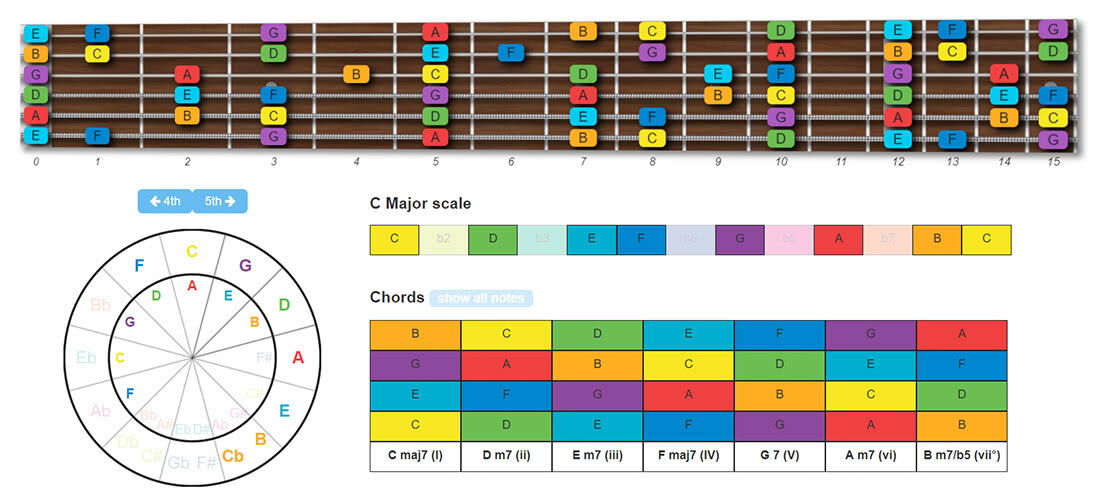
The Circle of Fifths is an essential tool in music theory, particularly for guitarists and composers. It provides a visual representation of the relationships between different keys, helping musicians understand scales, chords, and their connections. The Circle can simplify the process of key changes and enhance improvisation skills, making it a fundamental concept for both novice and experienced players.The Circle of Fifths is structured in a circular format, with each position representing a key that is a perfect fifth apart from its neighbors.
Starting from the top and moving clockwise, each key increases in sharps, while moving counterclockwise decreases in sharps and introduces flats. This arrangement helps musicians visualize key signatures and their corresponding sharps or flats, making it easier to navigate through different musical pieces.
Positions and Corresponding Keys in the Circle of Fifths
The significance of each position on the Circle of Fifths lies in its relationship to other keys. Below is a detailed description of each position, including the number of sharps or flats in each key signature:
- C Major
-No sharps or flats. This is the starting point of the Circle and serves as a reference for all other keys. - G Major
-One sharp (F#). This key is often one of the first learned by guitarists due to the simplicity of its chords. - D Major
-Two sharps (F#, C#). Known for its bright sound, D Major is common in various musical styles. - A Major
-Three sharps (F#, C#, G#). This key is frequently used in rock and pop music. - E Major
-Four sharps (F#, C#, G#, D#). E Major features prominently in many guitar solos and compositions. - B Major
-Five sharps (F#, C#, G#, D#, A#). While more complex, it is used in advanced compositions. - F# Major
-Six sharps (F#, C#, G#, D#, A#, E#). This key is less common but valuable for specific genres. - C# Major
-Seven sharps (F#, C#, G#, D#, A#, E#, B#). The most complex major key, often found in classical music.
- F Major
-One flat (B♭). This key offers a mellow sound, often used in jazz. - B♭ Major
-Two flats (B♭, E♭). Common in brass and woodwind ensembles, this key has a warm tone. - E♭ Major
-Three flats (B♭, E♭, A♭). E♭ Major is prevalent in orchestral and choral music. - A♭ Major
-Four flats (B♭, E♭, A♭, D♭). This key is widely utilized in jazz and R&B. - D♭ Major
-Five flats (B♭, E♭, A♭, D♭, G♭). D♭ Major is rich and full, often found in piano compositions. - G♭ Major
-Six flats (B♭, E♭, A♭, D♭, G♭, C♭). This key is primarily seen in classical music. - C♭ Major
-Seven flats (B♭, E♭, A♭, D♭, G♭, C♭, F♭). The least common major key, typically used in advanced contexts.
“The Circle of Fifths is not just a tool for memorization but a framework for understanding the relationships between keys in music.”
The historical background of the Circle of Fifths dates back to the Renaissance, where it began to formalize the understanding of tonal relationships. It was during this period that composers started exploring harmony, leading to the establishment of major and minor scales. The significance of the Circle has remained throughout the evolution of music theory, becoming a staple in the study of Western music.By understanding the Circle of Fifths, guitarists can improve their playing, facilitate easier transpositions, and enhance their improvisational skills, allowing for greater creativity and expression in their music.
The Circle of Fifths and Guitar Tuning
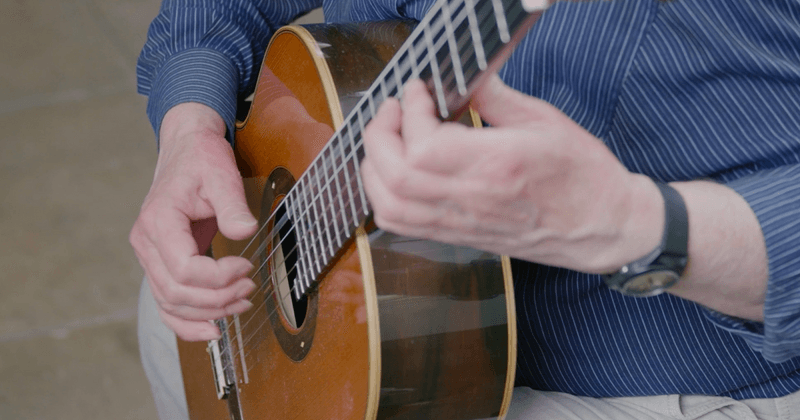
The Circle of Fifths is a vital tool not only for understanding music theory but also for practical applications such as tuning a guitar. Utilizing this concept can assist players in achieving accurate tuning, which is fundamental to producing harmonious sounds and enhancing overall musical performance. By understanding the relationship between the Circle of Fifths and guitar tuning, musicians can improve their proficiency and musicality.The Circle of Fifths provides a visual representation of the relationships between different keys and their corresponding notes, which directly relates to guitar tuning.
Each segment of the circle represents a key or a note, and the fifths refer to the interval between these notes. Tuning a guitar accurately involves understanding these relationships, as they can guide players in tuning each string to its proper pitch.
Using the Circle of Fifths to Tune a Guitar
Tuning a guitar using the Circle of Fifths can be a straightforward process when followed step by step. The standard tuning for a guitar from the lowest (6th) string to the highest (1st) string is E-A-D-G-B-e. Below is a guide to tuning your guitar with the Circle of Fifths.
1. Identify the Open Strings
Start by recognizing the standard tuning of the guitar, which includes the notes E, A, D, G, B, and e. These notes follow the Circle of Fifths in their respective positions.
2. Use a Tuner or Pitch Pipe
Utilize an electronic tuner or a pitch pipe that can provide reference pitches for each of the open strings.
3. Tune the 6th String (E)
Begin by tuning the lowest string (6th string) to the note E. This note is the starting point and is often represented at the top of the Circle of Fifths.
4. Tune the 5th String (A)
Next, tune the 5th string to A. A is located a fifth above E in the Circle of Fifths.
5. Tune the 4th String (D)
Continue by tuning the 4th string to D, which is a fifth above A.
6. Tune the 3rd String (G)
Proceed to the 3rd string and tune it to G, a fifth above D.
7. Tune the 2nd String (B)
Tune the 2nd string to B, which is a fifth above G.
8. Tune the 1st String (e)
Finally, tune the highest string (1st string) to e, a fifth above B.Maintaining correct tuning for all strings is crucial for producing the desired sound.
By following the Circle of Fifths, guitarists can ensure that all strings are tuned with respect to one another, leading to a harmonious sound.
Understanding the relationship between open strings and the Circle of Fifths enhances the guitarist’s ability to tune effectively. The open strings of a guitar are themselves a representation of the intervals defined in the Circle. For instance, the interval between the adjacent strings reflects the perfect fifths that are illustrated in the Circle. This conceptual framework helps in grasping how each string’s pitch relates to another, facilitating better tuning practices and musical understanding.In summary, the Circle of Fifths serves as a powerful ally in the tuning process, guiding guitarists to achieve accurate pitches and harmonious soundscapes.
By integrating this knowledge into regular tuning routines, musicians can enhance their skills and overall sound quality.
Chord Progressions Using the Circle of Fifths
The Circle of Fifths serves as a powerful tool for musicians to create and understand chord progressions effectively. By utilizing this visual representation of musical relationships, guitarists can explore a variety of chord progressions that enhance their playing and composition skills. This segment will delve into common chord progressions derived from the Circle of Fifths, as well as the methods to construct both major and minor chord progressions, and how to transpose songs using this instrumental guide.
Common Chord Progressions
Chord progressions are essential to creating musical phrases and establishing the tonal foundation of a piece. Below is a list of some common chord progressions based on the Circle of Fifths.
- I – IV – V (C – F – G)
-A classic progression used in countless songs. - I – vi – IV – V (C – Am – F – G)
-Known for its emotional impact, this progression is popular in pop music. - ii – V – I (Dm – G – C)
-A staple in jazz music, leading smoothly back to the tonic. - I – V – vi – IV (C – G – Am – F)
-Often referred to as the “pop-punk progression,” widely recognized in modern music. - I – IV – iii – vi (C – F – Em – Am)
-Creates a poignant sound, often used in ballads.
Constructing Major and Minor Chord Progressions
Understanding how to construct major and minor chord progressions using the Circle of Fifths allows guitarists to create harmonically rich music. Major chords are typically derived from the first, fourth, and fifth degrees of the scale, while minor chords arise from the second, third, and sixth degrees.To construct a major chord progression:
- Identify the tonic (first degree) of the scale.
- Move clockwise on the Circle of Fifths to select additional chords up to the fifth degree.
- Combine these chords to form a progression, such as I – IV – V.
To create a minor chord progression:
- Start with the tonic of the minor scale.
- Locate the relative major key using the Circle to find the corresponding major chords.
- Use the chords built on the second, third, and sixth degrees along with the tonic to form progressions, such as i – iv – v.
In any key, moving clockwise along the Circle of Fifths provides access to chords that naturally complement one another.
Transposing Songs Using the Circle of Fifths
Transposing songs using the Circle of Fifths allows guitarists to shift the key of a piece to suit vocal ranges or instrumental preferences. This process can be simplified through an understanding of the Circle’s layout.To transpose a song:
- Determine the original key of the song and locate it on the Circle.
- Identify the new key you wish to transpose to, finding it on the Circle as well.
- Count the number of steps taken clockwise or counterclockwise to move from the original key to the new key.
- Apply this interval to all chords in the song by moving each chord the same number of steps on the Circle.
For example, if a song is in the key of C and you want to transpose it to the key of D, you would move two steps clockwise, changing chords from C to D, F to G, and so forth.
Transposing with the Circle of Fifths allows for seamless transitions between keys, keeping the harmonic integrity of the music intact.
Applying the Circle of Fifths in Improvisation
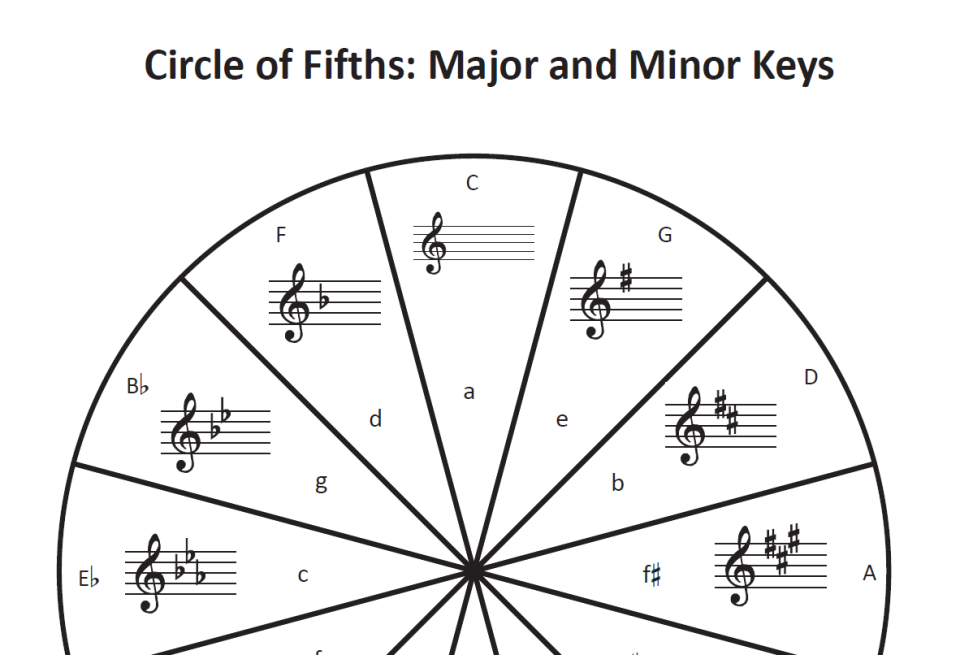
Improvisation is a vital skill for any guitarist, allowing for personal expression and creativity in musical performance. The Circle of Fifths provides a structured approach to improvisation, offering a roadmap through various chords and key signatures. By utilizing this tool, guitarists can enhance their solos and create more cohesive melodic lines that resonate with the underlying harmony.The Circle of Fifths is not just a theoretical framework but a practical guide that facilitates better improvisational choices.
One primary technique is to identify target chords within the Circle and use them as anchors for improvisation. By understanding the relationships between chords, musicians can create compelling phrases that flow seamlessly within a progression.
Target Chords Identification
Recognizing target chords is essential to improvisation with the Circle of Fifths. By selecting specific chords as focal points, guitarists can structure their solos around these elements. The following steps Artikel this process:
1. Choose a Key
Start by selecting a key to establish the tonal center of your improvisation. For instance, if you choose C major, the Circle directs you to the corresponding chords: C, G, Am, F, Dm, and E7.
2. Identify Chord Functions
Understanding the function of each chord—whether it is tonic, subdominant, or dominant—helps in determining which chords to emphasize during your improvisation. For example, the V chord (G) naturally resolves to the I chord (C), making it a strong target.
3. Explore Related Chords
Use the Circle to identify relative minors and parallel chords. In C major, for example, A minor is the relative minor, and exploring its tones can enrich your improvisation around C major.
4. Practice Targeting Chords
Regularly practice improvisation by targeting specific chords within a progression. Play phrases that highlight the notes from the chord tones, ensuring that your improvisation aligns with the harmonic structure.
Exploring Scales through the Circle
Using the Circle of Fifths to explore different scales can significantly expand a guitarist’s improvisational palette. Each chord around the Circle can be paired with specific scales that complement its tonal qualities. Below are key scales associated with various chords:
Major Scale
The major scale aligns with the I chord. For example, in C major, play the C major scale over C.
Minor Scale
The natural minor scale corresponds to the vi chord. In C major, use the A minor scale over Am.
Blues Scale
This scale can be effectively used with dominant chords (V7). For G7, incorporate the G blues scale to add a unique flavor.
Pentatonic Scales
The major and minor pentatonic scales can be used interchangeably with major and minor chords. For instance, use the C major pentatonic over C major and the A minor pentatonic over Am.By practicing these scales in relation to the Circle, guitarists can create solos that are not only melodically interesting but harmonically grounded and cohesive.
“The Circle of Fifths transforms the improvisational landscape, allowing musicians to navigate through chords and scales with confidence and creativity.”
Enhancing Songwriting with the Circle of Fifths
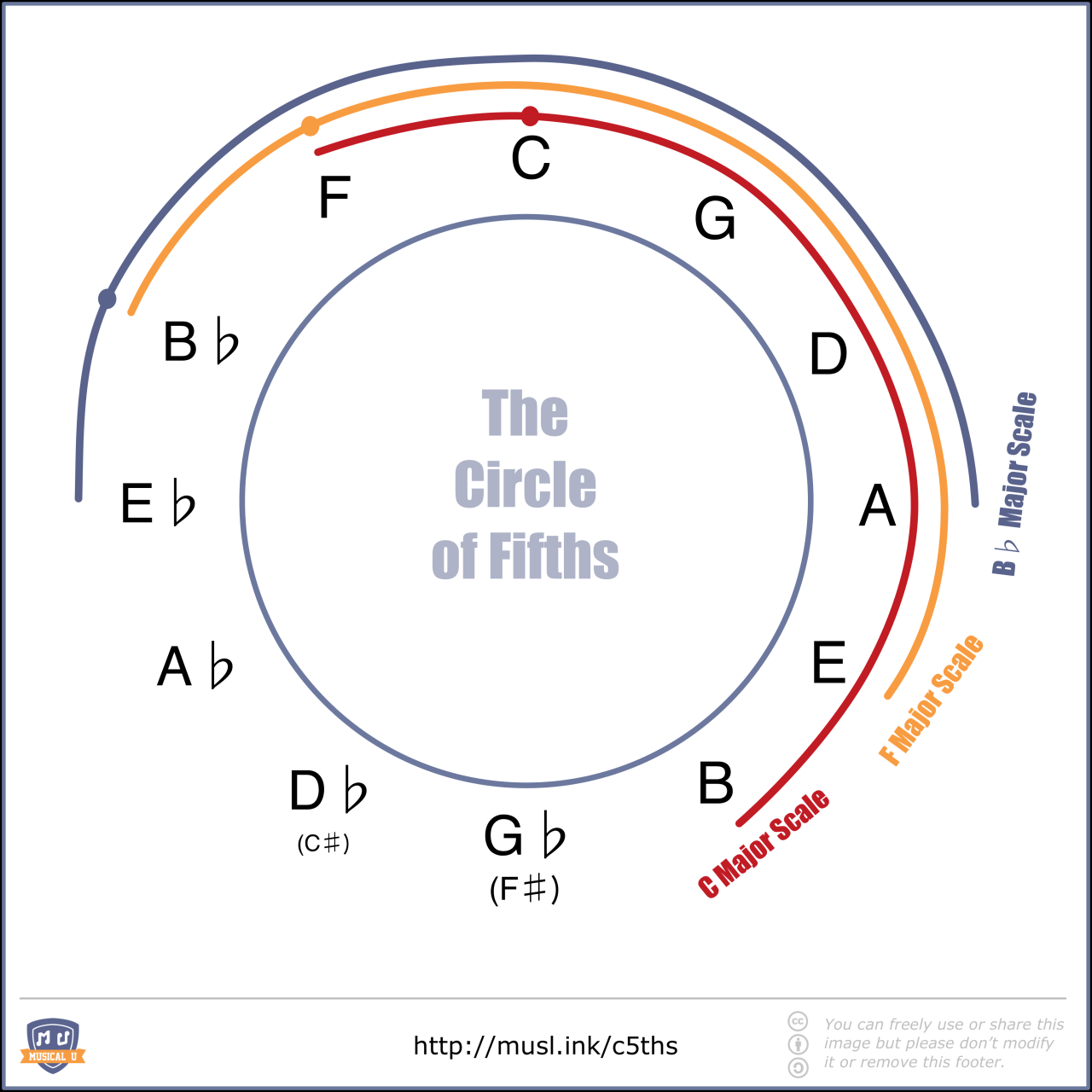
The Circle of Fifths is not only a valuable tool for understanding relationships between musical keys but also serves as a powerful aid in the songwriting process. By utilizing this visual representation of tonal relationships, songwriters can create engaging melodies, harmonies, and structures that resonate with listeners. This section will explore methods for incorporating the Circle of Fifths into your songwriting, how it creates tension and resolution, and provide examples of famous songs that effectively use this concept.
Methods for Incorporating the Circle of Fifths in Songwriting
Using the Circle of Fifths can enhance your songwriting by providing a framework for chord selection and progression. Here are several effective methods:
- Chord Progressions: Begin your songwriting by selecting a key, then use the Circle of Fifths to choose related chords. Moving clockwise will typically yield a sense of consonance, while moving counterclockwise introduces tension.
- Modulation: Experiment with modulating to closely related keys found on the Circle. This can create a fresh sound within your song while maintaining cohesion. For example, transitioning from C major to G major introduces a new dimension without straying too far from the original tonality.
- Verse and Chorus Structure: Use the Circle to structure your verses and choruses. By selecting chords that are adjacent on the Circle, you can create a natural flow that enhances the emotional impact of the song.
- Incorporating Extended Chords: Explore more complex harmonies by adding seventh, ninth, or other extended chords derived from the Circle. This can enrich your composition and provide unique textures.
The Role of the Circle in Creating Tension and Resolution
The Circle of Fifths is instrumental in establishing a dynamic balance of tension and resolution within a composition. Tension is often created by moving to chords that are farther away from the tonic, while resolution brings the music back to more stable, consonant chords.
“Tension is the emotional pull that engages listeners; resolution provides the satisfying release they crave.”
When creating tension, consider these approaches:
- Diatonic Chord Progressions: Start with a simple I-IV-V progression. Introduce tension by substituting a vi or ii chord before resolving back to the tonic.
- Chromatic Approaches: Use chromatic chords or borrowed chords from parallel keys to add unexpected twists that create a sense of urgency.
For resolution, focus on the following techniques:
- Strong Cadences: Conclude phrases with authentic cadences (V-I) to provide a sense of closure. This technique is a staple in many popular songs.
- Circle of Fifths Progressions: Use progressions that follow the Circle, such as I-vi-ii-V, which naturally leads back to the tonic and creates a satisfying resolution.
Examples of Famous Songs Utilizing the Circle of Fifths
Numerous renowned songs have effectively employed the Circle of Fifths in their composition. These examples illustrate how the Circle can enhance songwriting:
- “Let It Be” by The Beatles: This iconic song employs a simple yet effective chord progression derived from the Circle, creating a sense of familiarity and emotional resonance.
- “Pachelbel’s Canon in D”: This classical piece showcases a chord progression that moves through the Circle, demonstrating its timeless appeal and harmonic richness.
- “Sweet Home Alabama” by Lynyrd Skynyrd: The song features a straightforward progression that exemplifies the use of the Circle of Fifths to create a catchy, memorable structure.
Visualizing the Circle of Fifths on Guitar
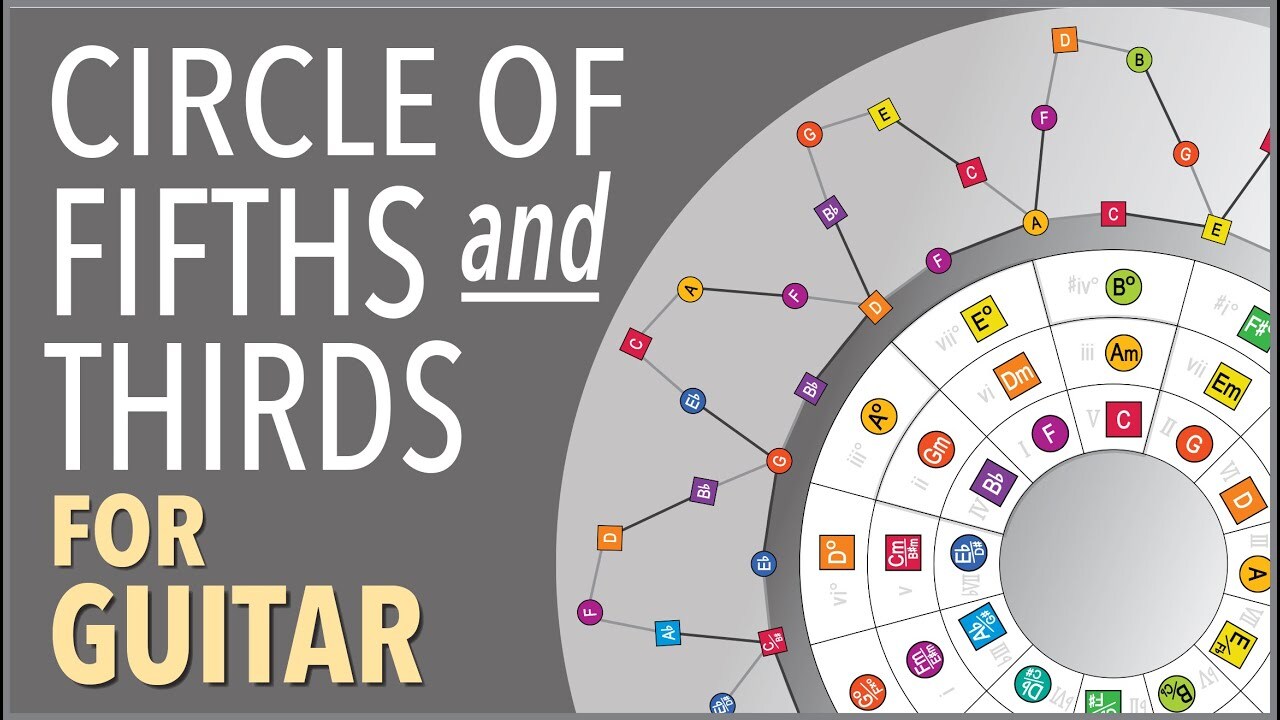
Visualizing the Circle of Fifths can significantly enhance a guitarist’s understanding and application of music theory. This visual tool provides a clear framework for recognizing relationships between keys, scales, and chords. By associating the Circle of Fifths with guitar-specific elements, players can more effectively utilize this concept in both performance and composition.To create a practical visualization of the Circle of Fifths for guitarists, diagrams that include chord shapes, scales, and finger placements are essential.
These diagrams not only depict the circle itself but also illustrate how various chords connect and transition within the circle. Such visual aids can help guitarists quickly grasp the relationships between different keys and chords, making it easier to navigate through songs and improvisation.
Designing Diagrams for Guitar Players
Incorporating diagrams specifically designed for guitarists into the Circle of Fifths can facilitate a deeper understanding of chord relationships. Below are examples of key components that should be included in these diagrams:
- Chord Shapes: Each key in the circle should display its corresponding major and minor chord shapes. For instance, the key of C major will show C, Am, Dm, Em, F, G, and Bdim chord shapes.
- Finger Placement: Adding finger placement diagrams for each chord can aid in memorization and practical application during practice sessions.
- Scales: Alongside chord shapes, include the major and minor scale patterns that correspond to each key in the circle, helping players visualize scale relationships.
These visual representations can serve as an invaluable resource for guitarists looking to deepen their theoretical knowledge while enhancing their practical skills.
Tips for Memorizing the Circle of Fifths
Utilizing visual aids can greatly assist in memorizing the Circle of Fifths on guitar. Here are effective strategies to enhance retention through visualization:
- Color-Coding: Use different colors for each key on the Circle of Fifths diagram. Associating colors with specific chords can create visual cues that make it easier to remember key relationships.
- Chord Progression Practice: Regularly practice common chord progressions that follow the Circle of Fifths. This practical application reinforces memorization through active playing.
- Flashcards: Create flashcards that feature a key on one side and its corresponding chord shapes and scale on the other. Frequent review of these flashcards enhances recall and builds familiarity.
- Visualization Techniques: When practicing, visualize the Circle of Fifths in your mind while playing. This mental connection between the diagram and your finger movements on the guitar can solidify your understanding.
By implementing these techniques, guitarists can effectively memorize and utilize the Circle of Fifths, leading to improved musicianship and creativity.
Advanced Applications of the Circle of Fifths
The Circle of Fifths is not only a valuable tool for understanding basic music theory but also plays a significant role in advanced musical applications. This section delves into complex chord substitutions, modulation techniques, and an analysis of the Circle’s influence across various musical genres. By mastering these advanced applications, guitarists can enhance their creativity and expand their repertoire.
Complex Chord Substitutions Based on the Circle of Fifths
Chord substitutions are an essential aspect of advanced harmony and can add depth and color to guitar playing. Utilizing the Circle of Fifths, musicians can explore various substitutions that create interesting harmonic progressions. For instance, a common substitution involves replacing a tonic chord (I) with its relative minor (vi) or a dominant seventh chord (V7) with a diminished chord (vii°).
These substitutions maintain the underlying key center while providing a fresh sound to the progression.
Consider the key of C major. The chords within this key are C (I), Dm (ii), Em (iii), F (IV), G (V), Am (vi), and Bdim (vii°). By employing the Circle of Fifths, one can substitute the G7 chord (V7) with the F#m7b5 chord (ii°), creating a smoother transition to the Bm chord (vi in the key of D major).
Such substitutions elevate the harmonic interest and encourage creative exploration.
“Substituting chords based on their positions within the Circle of Fifths can lead to innovative progressions in any genre.”
Modulation Techniques Using the Circle
Modulation is the process of changing from one key to another, and the Circle of Fifths provides a clear visual representation of how to navigate these transitions smoothly. Modulation can be achieved through various methods, including direct modulation, pivot chord modulation, and common tone modulation.
One effective approach is through the use of pivot chords that are shared between the original key and the target key. For example, in the key of C major, the G (V) chord can effectively pivot to A minor (vi) when modulating to the key of E minor. This technique ensures a seamless transition while retaining the listener’s interest.
Additionally, utilizing chromatic mediants—chords that are a major or minor third apart—can create striking modulations. For instance, transitioning from C major to E major can be accomplished by introducing A major as a chromatic mediant, leading the listener to an unexpected yet harmonious key change.
“Effective modulation expands the emotional palette of a piece, offering new perspectives on familiar themes.”
Application of the Circle in Different Musical Genres
The versatility of the Circle of Fifths is evident in its application across various musical genres. From classical to jazz, and rock to pop, the Circle serves as a foundational tool for composers and performers alike. Each genre exploits the Circle’s principles uniquely, contributing to its rich tapestry.
In jazz, for instance, the Circle of Fifths is frequently employed to construct chord progressions that establish tension and resolution. The ii-V-I progression is a staple, where the movement through the Circle creates a sense of forward momentum. This progression can be altered with various substitutions and extensions, showcasing the improvisatory nature of jazz.
In contrast, rock music often uses the Circle to create powerful anthems, relying on straightforward I-IV-V progressions. Yet, rock musicians commonly incorporate borrowed chords from parallel keys, allowing for unexpected harmonic shifts that keep the music dynamic.
Pop music, on the other hand, frequently utilizes the Circle for effective songwriting, especially in crafting catchy hooks and memorable choruses. The predictable yet engaging movement around the Circle lends itself to memorable progressions that resonate with listeners across the globe.
“Different genres utilize the Circle of Fifths to create unique sounds, yet the underlying principles of harmony remain constant.”
Conclusive Thoughts
In conclusion, mastering How to Use the Circle of Fifths on Guitar opens a world of musical possibilities. By integrating this framework into your practice, you stand to enhance your technical skills, creativity, and overall understanding of music theory. Whether you are a beginner or an experienced musician, the Circle of Fifths is a vital resource that can elevate your guitar playing to new heights.